Duo.
Duo.
A multi-modal desk lamp
for task and ambience
A multi-modal desk lamp
for task and ambience


Background.
Background.
An ergonomically considered chair
that fits a range of body types.
An ergonomically considered chair
that fits a range of body types.
A carbon fiber + steel hybrid chair you can work and relax in.
A carbon fiber + steel hybrid chair you can work and relax in.
ROLE
Designer, Fabricator
TIMELINE
5 Weeks
MATERIALS
CFRP, Steel, TPU
ADVISOR
Kimberly Snyder
INTERACTIVE • USDZ
Walk around it.
In your space.
Drag to rotate and interact with the model.
Tap View in AR on iPhone or iPad to drop a life size model into your room.
ASSET
Intanso3D.usdz
AR FORMAT
Apple Quick Look
SCALE
1 : 1
RENDERER
spline.design
Research.
Research.
A chair feels different for every body. Research started in showrooms and ended with eleven volunteers in an Ergobox.
A chair feels different for every body. Research started in showrooms and ended with eleven volunteers in an Ergobox.
SHOWROOM SURVEY
DWR
HERMAN MILLER
CB2
IKEA
A Saturday in Atlanta showrooms spent sketching, measuring, sitting, and dissecting every chair turned small ergonomic details into field notes.
4 SHOWROOMS / 40+ REFERENCE CHAIRS


ERGONOMICS REFERENCE
THE HUMANSCALE MANUAL
Seat height, backrest angle and recline geometry came straight off the Humanscale seating guide, then got cross-referenced against modern chair dimensions before a single line was drawn.
18"
SEAT DEPTH
INT’L AWARDS
17"
SEAT HEIGHT
INT’L AWARDS
15"
BACK HEIGHT
INT’L AWARDS
103º
SEAT BACK ANGLE
INT’L AWARDS
FULL SCALE TESTING
ERGOBOX EVALUATION
Using the measurements from both the reference chairs and the Humanscale manual, a scale seat was constructed to test the ergonomics of the measurements
21
INDIVIDUALS
INT’L AWARDS
5
SEAT PROFILES
INT’L AWARDS
2
FAVORITES
INT’L AWARDS
FINDING
Back 1 won with everyone 5′ 3″ and under. Everyone else picked back 2, so back 2 became the shell, with the lumbar curve pulled down an inch.

Ideation.
Ideation.
Forty silhouettes on paper, then straight into true scale before anything got cut
Forty silhouettes on paper, then straight into true scale before anything got cut


SKETCH DEVELOPMENT
My sketch ideation revolved around looking at my inspiration board and placing my own twist onto them for a variety of shapes and silhouettes.
SCALE CHECK • AR
Sketch models moved the form into 3D fast. Dropping the model into the room at 1:1 through AR allowed me to compare to real chairs.
FUSION 360
FORM MODELING
AUGMENTED REALITY

3D FORM MODELING
FUSION 360
RHINO
The Seat and Back were seamlessly modeled in Fusion 360 through SubD Form Modeling to eliminate all seams and surface imperfections. The form was then brought into Rhino for the bent legs and joinery.
ZEBRA ANALYSIS / SEAMLESS SURFACES
TECHNICAL DRAWINGS AND SCALE
This concept render shows the final design I landed on for the project and the dimensions are near final with the full version


JOINERY AND HARDWARE
All the joinery involes 1.5" screws going through a predrilled hole in the frame tubing and interlocking with a threaded insert built into the TPU Spacer

Prototyping.
Prototyping.
Being completely new to Carbon Fiber, intensive research and half scale tests were crucial to saving time and money.
Being completely new to Carbon Fiber, intensive research and half scale tests were crucial to saving time and money.


MATERIAL TESTING
My introduction to carbon fiber was a small scale test using a PETG mold layered with mold release, resin and carbon fiber
INITIAL FINDINGS
My first test piece showed that I should be using a lot more resin to fill in the gaps and that curved elements added a lot more structure than initially expected.
PETG MOLD
WET LAYUP
CARBON FIBER REINFORCED PLASTIC
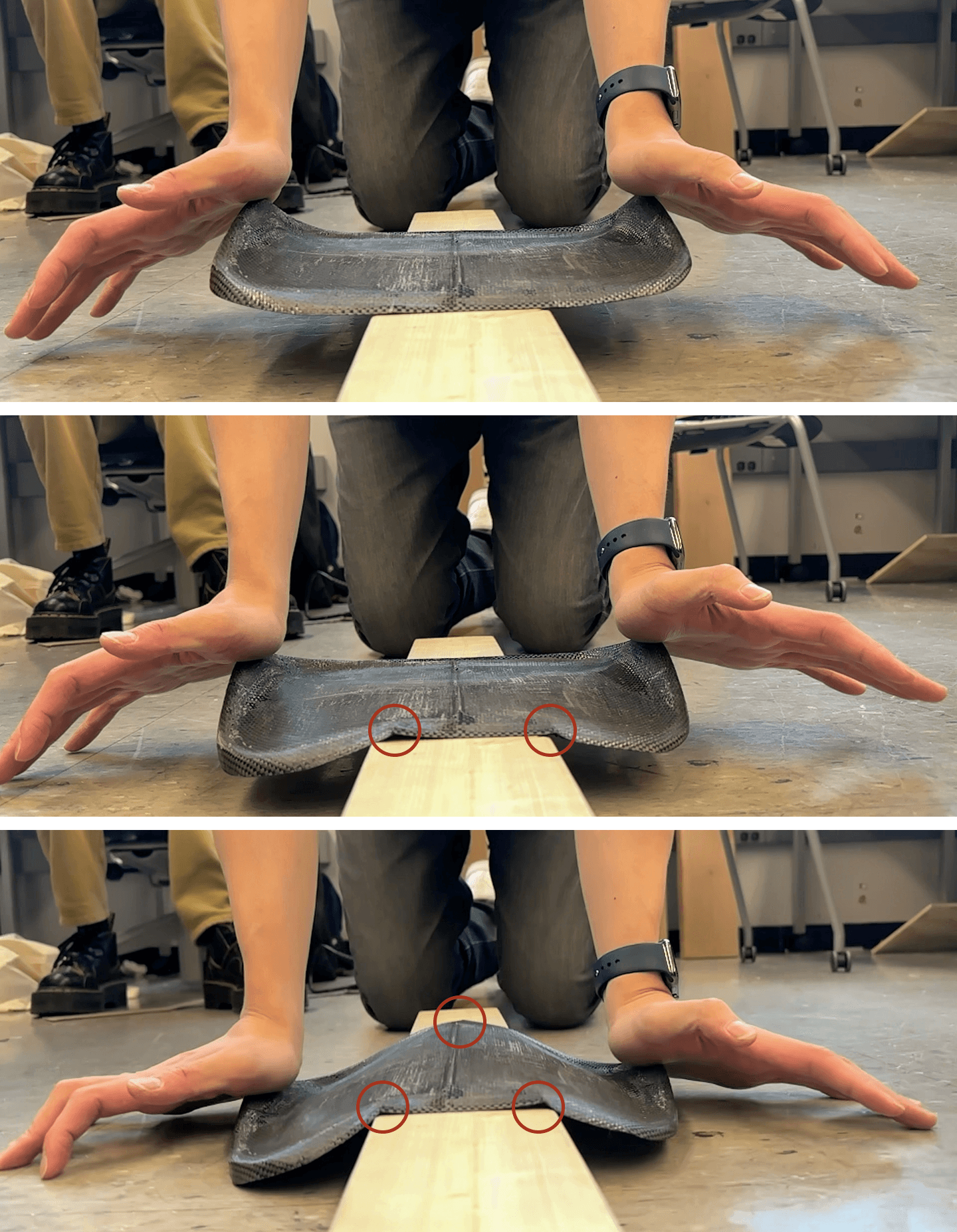
STRESS TESTING
Flat regions acted as the main point of failure while the 3D geometry maintained its structure during the majority of the test. The redesign will continue the curve to reinforce the overall structure.

CARBON FIBER WET LAYUP
My second attempt was on the half scale back piece of the chair. Using more resin, filling in the gaps resulted in a higher quality finish.

Final Model.
Final Model.
After multiple material tests with carbon fiber and figuring out the best techniques, I got started on the final model.
After multiple material tests with carbon fiber and figuring out the best techniques, I got started on the final model.
MANUFACTURING THE CHAIR LEGS
The legs posed a difficult challenge for the whole chair building process. The problem was the unique flared design and its tendency to spread out when force was applied down.


MAKING THE MOLD FOR SEAT & BACK
The templates were made of 15 total 3D printed pieces specially designed for the wet layup process. They were then assembled and finished with mold release to make the post process easier.


MAKING THE SEAT & BACK
After following the wet layup process, I trimmed the excess fibers to my intended size. I sanded down the imperfections before spraying a gloss finish. I cleaned everything up with a polishing compund.


AUTOMOTIVE POLISHING
After giving the chair a clear coat, the next step was to apply polishing compound and buff out all the micro scratches.
ASSEMBLY
Using a TPU middle piece epoxied onto the chair seat and back, they were able to be screwed easily together.
CARBON FIBER POLISHING
TPU DIVIDER PIECE
MILD STEEL LEGS


CREDITS
INSPIRATION CREDITS
Amiti Arunmozhi
Davis Gentry
Alex Trimmingham
Kyle Hagerty
Andy Cho
Jett Lopez
SPECIAL THANKS
Kimberly Snyder
Tripp Edwards
Wayne Li
PHOTOGRAPHY
Kevin Park
Daniel Lee
Davis Gentry
STATUS
STATUS
Atlanta, Georgia
Atlanta, Georgia
Design Bloc Assistant
Design Bloc Assistant
SITE
SITE
Version 09.2026
Version 09.2026
Typeface Provided by TypeType
2026 Kevin Park · All projects shown with permission of credited collaborators.